Grumpy dinner

Tonight I made a fabulous meal for my precious family. Anthony has started taking a maintenance med for his gout, so we’re trying to get a little red meat back on the menu. Jesse and I tend to be a little anemic without red meat. What can I say; cow calls to us.

I got a flank steak and cooked it in a style that should satisfy both my Korean and Anthony’s English heritages: I boiled it madly for two hours.

That’s where the cultural overlap ends. I shredded and seasoned the meat with sesame and red pepper flakes and garlic (I did a small separate batch for the kids, in which I replaced the red pepper with a little brown sugar and soy sauce). I reduced the broth a bit for flavor, and added some tofu and thin-sliced carrots and onions and garlic. I served it with rice and seaweed and home-made kimchi.

Am I the BOMB?

img_2946

img_2948

What could be more nutritious and delicious than this meal?

If you read my blog regularly, you know what’s coming next:

Nick was super hungry after school, so while that blessed meat was boiling away, he ate two full bagels loaded with cream cheese. He wasn’t even remotely hungry by the time we sat down to dinner.

But Anthony was in English-mother mode, grumpy about Nick never being able to sit still at meals and never eating what I cook. So he ordered Nick to the table and required him to eat some meat. Nick choked the first bite down and then required catsup. I think he also ate the tofu out of his soup. I considered the meal a success because he didn’t gag and vomit.

As the struggle to eat commenced, Anthony and I became weirdly irate about Nick’s inability to stay in his chair, so I grabbed my phone and set a timer for three minutes. Could Nick stay in his chair for three minutes??

No, we discovered. He could not.

Meanwhile, during our dinner battle with Nick, Jesse was sitting on the sofa refusing to come to the table. There was much whining associated with this problem.

“Jesse, can you please just come to the table and not make us ask again, so this doesn’t turn into another fight with you?”

Jesse put up a silent front, but eventually relented in the face of parental whining. She sat down, poured water on her rice, and quickly ate it with a fork. I did not know you could eat rice-in-water (a Korean comfort food, “muhl-bahp”) with a fork. I think we’ve discovered another one of Jesse’s odd talents.

Jesse eyed the meat suspiciously and ate a tiny bite. She picked the tofu out of her soup. And that was it.

As she ate, Nick (now departed from the kitchen) started wandering in with ziplock bags full of Christmas ornaments, which he placed all over our meal. Our settled plan (in my mind anyway) was to decorate the tree after dinner, but he was becoming impatient. We ordered him repeatedly to get out of the kitchen and take the ornaments with him, to no avail. He was frenetic; he just kept bringing those ornaments in.

Not long after her arrival at the dinner table, Jesse got up and left. I called her back.

“I made this special nutritious soup for you,” I wheedled, “to help you recover from all your sicknesses. It is full of good things to make you strong and healthy. Just pick up the bowl and slurp it.”

Gaaaaawd. I sounded just like my grandma and mom. I sounded like a crazy Korean lady pushing and pushing and pushing her totally amazing and to-die-for food on her kids. I rolled my eyes at myself, just as I used to roll them at my maternal forebears.

* * * * *

We survived dinner, mostly uneaten. We decorated the tree, and each child only broke one ornament. We had hot cocoa loaded with marshmallows and whipped cream. We washed dishes. The kids could not have cared less about my nutritious dinner. But my tummy and heart were happy after all.


Snow day Sunday

I wake up this morning and the snow is just starting to fall. I can barely see it, but there’s a haze of white on the ground in small patches, and that winter feel is in the air.

Our plan is to put up the Christmas tree and decorate it today. But first Anthony says we have to disappear the leaf pile that’s in the middle of our back yard. It’s a mighty big leaf pile, so this is going to be a lot of work. Anthony heads out first and I follow, leaving the kids to relax on the sofa with their iPads. While we rake and carry leaves into the woods, we start to hear some high-pitched noises. I think at first that it’s a neighborhood dog. Anthony disagrees.

“I think that’s Nick.”

We stand still for a moment and realize Anthony is right. We can see Nick standing in the living room. We can hear him screaming on and on. Anthony and I stand frozen, staring up at the living room window.

Anthony breaks down first. “Should I go in?”

I don’t offer to go instead.

Anthony disappears into the house and I get back to work. It feels like half an hour passes before I hear someone stomping out to me. I expect to see Anthony but instead it’s Jesse, looking freshly showered.

We sit on a couple stumps side by side.

“Was that Nick screaming earlier?”

“Yeah.”

“Wanna tell me what happened?”

Jesse gives me the blow-by-blow in an unemotional, matter-of-fact tone, the way you might expect to hear a beat cop presenting facts. “I was kind of teasing Nick on his iPad. Then he started yelling at me. I punched him in the eye. He pulled a bunch of hair out of my head. He kept screaming at me even when I said I was sorry, and I didn’t do anything more to him. Then he coughed on me and vomited snot on top of my head. So I took a shower.”

I let all that sink in for a while as we sit peacefully under the trees.

I remind Jesse that until just a few months ago, she was often really hostile toward Nick. Sometimes she still is. She would punch him in the car when we drove places, cough in his face, spit on him, stick her bare feet on his face. Nick is a patient kid, but he has his limits too. I remind her that when she was really down, we asked Nick to be patient and tolerant, because we were all just waiting for Jesse to feel better. Now I tell Jesse the same thing, as snow lands softly around us.  You need to give Nick time to forgive you for those long months. You can be tolerant and patient, just like he was.

Jesse nods in quiet acceptance. I can’t see even a trace of anger or resentment in her.

* * * * *

Everyone ends up outside for a little bit to finish up the leaf pile and take turns on the rope swing, and then we all head in. We’re still thinking about the Christmas tree, but also we’re feeling lazy. Jesse wants to play Monopoly, which she insists on pronouncing “mono” like the virus and “poly” like a roly-poly. Emphasis on “MO” and “PO.”

Anthony and I used to enjoy playing a variety of board games, but then our children were born. I keep hearing stories about how people have fun playing board games with their very young children, and I have to assume these tales are apocryphal. In our house, pulling out a board game is the equivalent of saying, “I’d like my life to suck for the next 15 to 20 minutes until we give up and put this damn game away again.”

But Anthony and I say yes and make Jesse set up the board. Last week when she asked to play, we tried to set it up for her and she went straight to Anxiety Land, tic’ing and twitching and doing lots of annoying things. So this time we let her habituate to all the pieces in her own way while we hang out in the kitchen. It works. We play fast-version, passing out all the property deeds first. Anthony makes a bunch of trades with Jesse straight away, excluding me entirely. He claims he’s being really, really fair. He ends up with two monopoly sets and all four railroads and something like thirteen properties. Jesse ends up with two monopoly sets and eight properties. I get bupkis, because no one is trading with me, and I start whining. Anthony always beats me at Monopoly.

The dice begin to roll in earnest, and the game doesn’t suck this time. Nick is the banker. Jesse takes forever to count out money when she needs to pay up, while Anthony and I stare silently at each other in grim solidarity. Nick runs around and around the table grabbing random things, moving houses here and there, and sneaking money to Jesse. About fifteen minutes in, attention spans have faltered and we leave the board on the table to finish the game later. Jesse wanders over to the sofa, covers herself entirely with a blanket, and promptly falls asleep.

* * * * *

Jesse’s still experiencing random bouts of extreme fatigue every day. We hope it’s the fallout of Lyme disease and that it’ll clear up some time in the next decade or two. I guess it’s possible that it’s something else. Her new meds? Depression? An as-yet-undiagnosed fatigue-inducing illness? Ennui?

Nothing I can do about it today, so Nick and I abandon Jesse and Anthony. Nick’s snow shoes are too small, so I need to take him shopping. As we prepare to leave, he harangues me about Pokemon cards. He wants more. His tenacity on this topic is just too awful for me to spell out for you, but he wins. We head over to Winkies and he buys two foil packs, one for him and one for Jesse.

Next we walk two storefronts down, to the bagel shop. Nick likes bagels and cream cheese, so that’s what he gets. We spend a good half hour poring over all the new Pokemon cards and determining how to divide them between Nick and Jesse most fairly. It’s quiet, relaxed fun with Nick. I recognize that I’m in the eye of the storm.

Unfortunately, I have more stops to make on this outing. I’m a mom and the housekeeper, so I always have errands to run. We drive over the Trader Joes for some basic groceries I need. While I shop, Nick keeps getting way, way too close to human beings he’s never met. I have no explanation.

Next it’s off to the outfitter to buy snow boots. It’s snowing in earnest now, and Nick is starting to act like a strung-out kid who needs to pee, only the emergency is that he needs to get home to play in the snow. “Look at all the snow! We need to go home NOW, mommy! Look at the snoooow!! I gotta go play in it! It’s gonna be so. much. fun!! Snow snow SNOWING!!!” After bizarrely confusing efforts to get him to pick a boot style, he tries on a pair. The guy helping us tells him to walk up a little ramp thing to emulate walking up a hill. Nick does that. Then he does it again. And again. And again. And again. We take the shoes.

Nick won’t stop haranguing me about getting home, even as I try to find him new gloves and  a hat. “How much longer will we be here, mommy? We have to go home NOW! It’s snowing! This is so awesome!” He jumps up and down in place, touching me and touching me. It’s slowing everything down and making me miserable.

I seek inspiration. I decide today is a good day to buy a fur-lined hat with ear flaps for myself. I find the most enormous, ridiculous-looking one and don it. I look like I’ve placed a live beaver on my head. This does the trick. Nick runs away in squawking embarrassment and refuses to be seen with me for the rest of the time we’re in the store.

Nick’s in such a rush that I rush too. We rush through checkout, and we rush out to the car. Then he stands there, suddenly peaceful, playing blithely with ice and snow that’s crusted up on the car. He won’t get in the car. I drop into my driver’s seat and roll down the window on his side. “GET IN THE CAR,” I snarl.

Half an hour of being harassed has gotten to me. We hit the road.

* * * * *

I drop Nick off at home, bring in our purchases, and head back out. I still need to go to a second grocery store and the gas station. When I leave the house, Nick is in the living room jumping up and down, arms flapping, keening about the snow and his new boots. Jesse is just rousing from the sofa, having taken a two hour nap.

I buy my last groceries and fill the tank, and then head back home. Snow is falling around me, big sticky flakes that really are lovely. I expect to come home to noisy kids who are fighting with each other, and a grumpy dad. But when I pull up to the house, I see Jesse and Nick making a snowman in our front yard. They barely notice that I’ve pulled in to the driveway. When I get out of the car, I hear their voices — cheerful, silly, cooperative.

They are playing together. They don’t need me.

I’m buoyed up in that moment. I almost cry. The  beautiful snow, my beautiful children, that pathetic little snowman. It’s evidence that, at least for now, life without behavior modification therapy is better. Jesse is finding her way to happy, because we’re making room for her to go there.

* * * * *

More things happen for the rest of the day, but it’s all good. We manage to get the tree up in its stand. We watch a couple movies – Frozen and Honey I Shrunk the Kids. Yay. We get the kids to bed.

After Nick falls asleep, I head downstairs. Anthony’s letting the dog out front and he motions for me to come outside. “Have you seen the trees?”

Everything is blanketed in this first sticky snow, each limb of each tree outlined in white. It’s quiet and beautiful.

A good first day of snow in my part of Wisconsin.

death of a tree

This year we decided that we would kill our own Christmas tree, for the first time ever.

Anthony wanted a freshly killed tree in the house. He hypothesized that it will keep longer than a previously-killed-and-shipped tree, and it won’t drop as many needles. Also less nascent mold, so less fear of allergies.

That all makes sense, but thoughts of cutting down our own tree kept making me think of Hans Christian Anderson’s poor Christmas tree. That stupid self-aware tree, full of dreams of grandeur and pageantry. He just wanted to be a f**ing Christmas tree, decorated to the nines, instead of a sorry feral-pine-in-the-woods. But after being chopped down and prettied up for a couple weeks, and all that hubris and grandness, he was thrown in a closet and forgotten and then turned into firewood. What a sorry, horrifying end.

I still remember reading that story as a little girl and bawling in shock. I think I was eight or nine. My Dad and I were at the book store, and this collection of “fairy tales” caught my eye. Mom and Dad always bought me any book I asked for. They never said no. I took the book home and got really, really sad. That stupid Christmas tree; in the end everything went wrong for it.

And that poor poor little mermaid. What was she thinking?? I knew nothing about metaphors and virginity. I just remember thinking how horrifying it was that she suffered such pain from turning her fishy tail bottom into human legs, and then it all went wrong, everything went wrong and the prince rejected her despite her legs and broke her mermaid heart. That sucked so bad. It was so unfair.

Also the sad, sad little match girl. Her story haunted me as I lay awake at night listening to the rats of Seoul scratch at the walls of my bedroom (honest), because I pictured her about my age. She was so destitute! She was so alone! What was she doing on a street by herself, such a little girl? Where did she get the matches she sold? Why didn’t any grown up help her? Why didn’t anyone help her? And she froze to death while having fantasies that never came true! Horrible!

Fairy tales? More like fairy nightmares. I don’t remember any fairies from reading Hans’s miserable tales, just desperate and sad beings who don’t get anything good in life.

Why am I going on and on about Hans Christian Anderson? I don’t think I meant to be telling you about that. What was I talking about?

Oh, right, our Christmas tree this year. Despite my obsessive thoughts about creepy Hans’s stories, I decided Anthony was right. And he reminded of the obvious: the tree is dead whether we cut it down or someone else does it.

We found a location where we could hunt fresh trees, still alive and healthy and well-fed. We knew the hunt wouldn’t actually be fair or wild, that the tree we decided to kill would never have a real chance of escape, having been raised in captivity just off Granville Road.

I told the kids excitedly of our decision this morning. “Kids, it’s time to go kill our Christmas tree!”

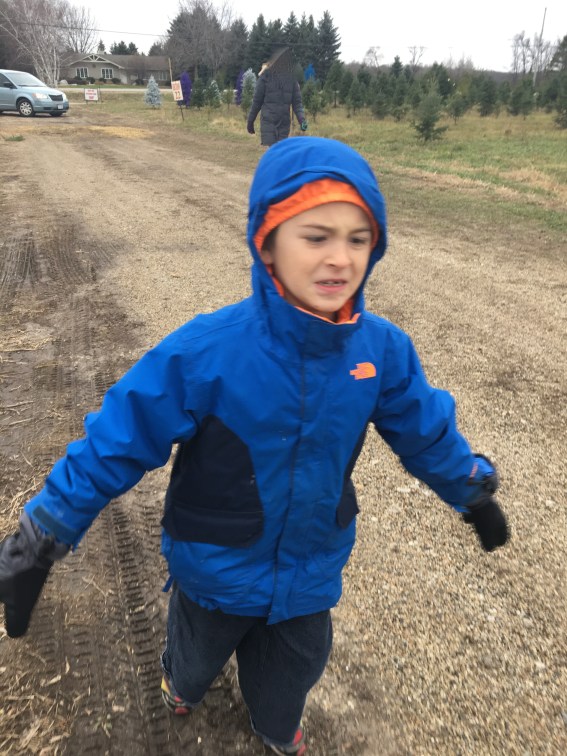
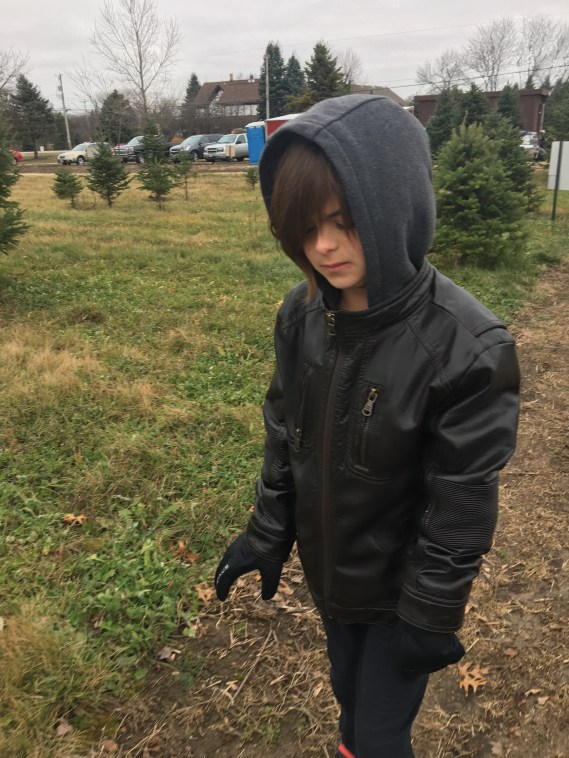
For some reason, this troubled them, and they seemed kind of gloomy and unhappy about it when we arrived at the tree ranch.

IMG_2921.jpg

img_2920

It’s possible that my occasional chanting — “Kill the beast! Kill the beast!” — didn’t help.

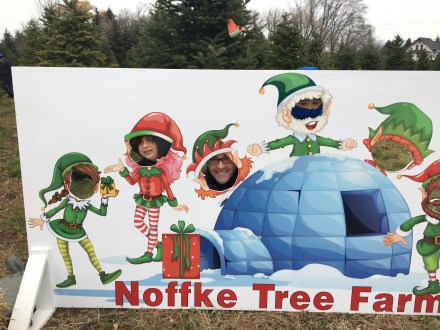
My family posed for pre-hunt shots, behind a wall that displayed the sort  of hunter regalia they should have been wearing while killing a tree. Nick seems to have some sort of Ninja mask on. Anthony looks way too happy about the looming death of a tree. Jesse looks like she’s farting.

img_2925

We wandered through fields of trees, tree-killing fields. We were only allowed to attack those trees marked for death with a red christmas tree tag. It didn’t take long for the kids to settle on their mark. They didn’t seem to relish the hunt — they just wanted to find a victim and get it over with. Frankly, I appreciated this quality in them. First they eyed some huge trees, 10 feet tall, far too large for our home to digest. After we explained the problem of ceiling height, the kids found this medium-sized beauty.

img_2927

A perfect size, plump and healthy, and you can see how happy they were.

We brought our own weapon to the site, a vicious curved Japanese pruning and cutting blade on a wood handle. Anthony refused to let me bring an axe. We would make the kill with our own devices and hands, not with any borrowed, dull saw.

I don’t have a picture of the saw, because I don’t have a weapons fetish. Nor do I have a photo of the kill; some images are sacred. Anthony lay flat on his side on the ground as he put saw to tree, and I held the tree up to keep it from falling on his head. It took no more than a minute or two for us to kill that tree. The brief event felt almost sacrificial (probably mostly because we’ve been binge-watching History Channel’s “Vikings” series off Amazon).

The kids were a little morose, a little sullen, as we marched the fallen tree to the sales hut. The nice man there put the corpse on a shaker device, where it shook wildly for 20 seconds to remove loose and dead needles and pine cones. Then he dragged it over to the wrapping station, where they shoved it aggressively through a narrow portal. It went in one end a loose and floppy dead tree. It came out the other end bound and gagged into a narrow package, and then we tied the carcass to the top of our car.

img_2929

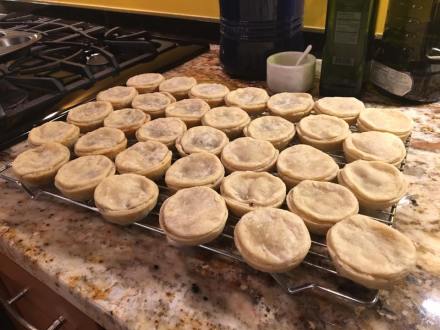
We’re going to decorate that thing tomorrow in our living room. To help us celebrate the clean kill, I made mince pies tonight.

15355738_10207997289636032_8351212422618248511_n.jpg

We’ll eat these cloying, fat-laden treats while we decorate the tree, covering it with lights and bits of plastic and ceramics and glass and fabric and various fetishes. I’m sure at some point I’ll remember how much I love our Christmas decorations and the memories they bring to mind, and we’ll decide, as we do every year, that it’s the most beautiful Christmas tree we’ve ever had.

But tonight, I’ll grieve a little for the beautiful little tree that met its demise for us today. When we’re done with it, some time in early January, Anthony will drag it out into our back yard, into the woods. He’ll dump it unceremoniously with the nine or ten other Christmas trees back there, or at least, what’s left of them among the woodlands decay.  It won’t be chopped up and burned, like Hans’s poor tree. It’ll just hang out in our woods, slowly rotting away and providing nutrients and life to whatever decides to eat it, live in or beneath it, or grow on it. So I suppose, in a way, it’ll always be alive and with us.

Meanwhile, after reading what I just wrote, I think I better work on improving my outlook and mood for the remainder of the holidays.


I am a person first

I’ve been learning about a really important movement in the disability community, called “people first.”

It’s a critical idea in self advocacy: I am a person first. I am not a disability first. When you visit the most general people first webpage, you will find the hilarious and brutal tag line: “Label Jars Not People.”

“People first” language makes us rethink how we refer to ourselves and others, and therefore how we perceive and interact with the world. Instead of “I’m OCD,” I would say “I’m a person with OCD” or “I’ve been diagnosed with OCD.” Instead of “He’s bipolar” I would say something like “He’s been diagnosed with a mood disorder.” Looking back, I would not have said “Jesse is dyslexic.” I would have instead said “Jesse has a reading disability” or, perhaps better yet, “Jesse needs some extra supports to help her learn to read.”

“People first” language and thinking challenges us to treat people with dignity; to view their limitations and differences not as definition but as situation; to ask ourselves how we can enable each person to have a rich and fulfilled life regardless of his individual weaknesses and strengths. We stop imposing a label, and we start seeing the whole person first, before the symptom or the disability or the challenge.

I know this movement has stayed front-and-center in my mind lately because I feel that I’ve stopped seeing Jesse as a person first. I mean, of course she’s a person and my beloved daughter. But, thanks to the omnipresence of Therapy, I started seeing her challenges first. Every morning when I woke up, I saw symptoms, strategies, interventions. I pixelated Jesse into a series of behavioral and emotional blips to contend with.

This is not how I should experience my daughter.

So I’ve been struggling to pull myself up to a place that’s  more consistent with who I’ve been for most of my life, a place where I see my child as a person, a whole being, who faces a set of challenges that only partially define her experience. I’m trying not to be too hard on myself as I make this transition, because I know that whatever mistakes I’ve made (and will make), I’m acting with love, with passion and compassion, and with big dreams of happiness for my children.

* * * * *

The last couple weeks, after yet another round of sickness and disease in the house — strep, snot, coughs, fevers, stomach aches, allergies, scrapes, cuts, burns, you name it — I’ve been really worn down. When everyone else gets sick, I’m there taking care of things for them. Food is made and delivered, blankets and pillows are arranged and puffed just so. I do extra dishes, make special treats, do more of the cleaning than usual. I check on meds, hydration, caloric intake. I fawn and pamper.

When I’m sick? I’m there taking care of things. Food is made and delivered, still by me. I do as much housework as I can. I take  care of my own meds, my own hydration, and my own caloric intake. I take care of myself.

I whine and whine about this —  sometimes to myself, sometimes to the wind, sometimes to my family but no one ever listens to me anyway. Why can’t I be spoiled just a little when I’m sick? Why can’t someone fawn on me and pamper me?

A friend brought over her kids today so she could go to the doctor with a family member. Her charming and sweet daughter sat in my kitchen having a snack. I said as gently as I know how, “Your mom sure seems tired and a little down, and I know she’s sick… Maybe you want to help her a little extra the next couple days. Like, spoil her a little.”

This delightful child looked at me blankly and answered in an innocent monotone. “Why?”

Yes, dear reader, I was polite. I bit my tongue. Neither did I laugh, which was hard. But here’s what I wanted to scream, not at this little girl in particular, but at the world, at my own kids, who take for granted how much they’ve disappeared me behind this label:

Before I gave birth to you, I was a human being. A real person.

I am a person first. I am not just “mom.” Rather, I am a person with children.

I am more than an allocated resource, here to meet your needs. I am more than your personal servant and assistant.

I am a person blessed with children, and also I am a person afflicted with children. I am a person surrounded by spawn who suck their every need out of me, and it never occurs to them to give anything practical back in return. (Not yet, anyway.) I am a person who has dreams, hopes, wishes, all of which have been shunted to the side for quite a few years now as I meet the needs of these other little people. I am a person who needs to sleep more, and I could use some supports in place to make that happen, because my minions don’t get it.  I am a person who needs more exercise and needs to eat better; but who has time for that with high-needs kids running around? I am a person who wants to study and learn and read more than I do, and I need some accommodations to make that happen, given my current condition. (The condition is called “MOM.”)

I am a person first, just like you, my children. I’m just waiting for you to grow up a little, to be old enough and wise enough to see me through the mask of your needs.

So I’m thinking maybe I have a pretty good idea how Jesse feels behind the label. Maybe I’ll peel it off her and stick it on a jar somewhere.


More moments of grace in a grumpy life

As we step away from a life driven by the frenzy of therapeutic interventions, spaces are forming for normal human behavior.

* * * * *

Last week Jesse and I had a normal parent-child conversation in the kitchen. We didn’t talk about diagnoses, therapeutic tools, exposures, competing responses, or what doctors tell us we should do. We were exploring the question of whether she allows some of her tic-behaviors to come out because she wants attention. I pointed out that a person can get attention in positive ways as well. This is a very challenging idea for Jesse, because she doesn’t see herself in positive terms. At the end of our chatter, I turned to the didactic side and gave her an example. “Like this,” I said. “Instead of yawping at your teacher, you could ask her if she needs help with anything. Then you will have her attention, but in a good way.”

By the time I got there, I wasn’t sure Jesse was paying attention anymore. She seemed distracted by something on the table. But I know Jesse tends to take in everything that happens around her. Like me, she seems to receive audio information best when she doesn’t look at the source and when her hands fidget, so I don’t judge. Visuals can be so distracting.

A few days later, Jesse walked over to me after I brought her home from school.  I was sitting at the desk in the kitchen doing something. She stood close to me, so her face was right next to mine. Her voice was very quiet and calm, not quite a whisper.

“Mom, remember that thing you told me about? Doing something positive to get attention?”

“Yeah,” I replied, as I continued with my work. (Such an attentive mom)

“I did that today.”

That got my attention. I looked up. “Tell me about it.”

Instead of yawping, Jesse went up to her teacher during study hall and asked if there was anything she could help with. And her wonderful teacher said yes, there was a big job to do. Together they moved all the desks around the classroom for one of the regular reorganizations. It was apparently an easy and cheerful experience, and Jesse was well-pleased that she was allowed to choose whose desk would go next to hers.

It worked. Without any therapists, therapeutic modalities, timers, aides, or competing responses. In that moment, with the help of a kind, compassionate, good-hearted teacher,  Jesse learned a sweet little lesson that no technical therapy or behavior chart will ever teach.

* * * * *

I woke up this morning to find both kids and the dog surrounding me like a cresting wave. Not a Maui 20-foot tube style wave for a change; more of a 3-foot wave on a flat beach. Pleasant.

The dog lay peacefully snuggling up next to me with my arm around her, flat on her back with four legs in the air, her head resting on my shoulder. Since she only weighs six pounds, it was just like having a newborn tucked up next to me, only furry.

Nick started right in as my eyes opened, telling me about his cool dream. “Me and all my friends was in Minecraft.”

Nice.

He found himself on a Minecraft beach, where he kept standing right where the waves crash, so he almost drowned. One of his friends was really badly hurt, but it turned out he was faking. They went into a house, a house that Nick had built in Minecraft in the real world, but here it was in his dream, even though in the real world he lost it. So. Much. Fun.

Jesse joined the chatter.  She and Nick started talking about “enchanted sticks,” and how they can make them on the Xbox1, if only we had that device.

“What’s an enchanted stick?” I asked. “Is it a wand?”

“No. It’s an enchanted stick.”

“Does it do magic?”

“No. It’s a stick.”

I was puzzled.  “Does it have special powers?”

The kids started giggling. “Mom, it’s an enchanted  stick,” tittered Jesse, saying the two words with a dramatic flick of her hands and a high-pitched, odd inflection that brought to mind the Knights Who Say Ni.

Nick added, “Yeah! It’s an ENCHANTED STICK.” 

Two knights in the house.

I was so confused. “What does it DO?” I demanded.

“It’s a stick.”

Helpful. “What’s the benefit of being enchanted?”

“When you hit someone with it, it hurts them!” The kids devolved into giggles and endless reiterations of “enchanted stick.” They grabbed their iPads and crawled under the covers together to play Minecraft.

They haven’t done that in months. Or maybe I just haven’t noticed it, because my head has been full of behavior charts and competing responses and breathing exercises and the next evolution. Being over-therapied taught me a whole new way to natter at my kids and avoid actual normal parenting.

But this morning, all of that didn’t own me. I woke up and didn’t do anything except lie there and accept the gift of my children.

As they huddled under the covers together, I rolled over and sighed in contentment.